How to Become a Radio Presenter in Kenya: A Step-by-Step Career Guide

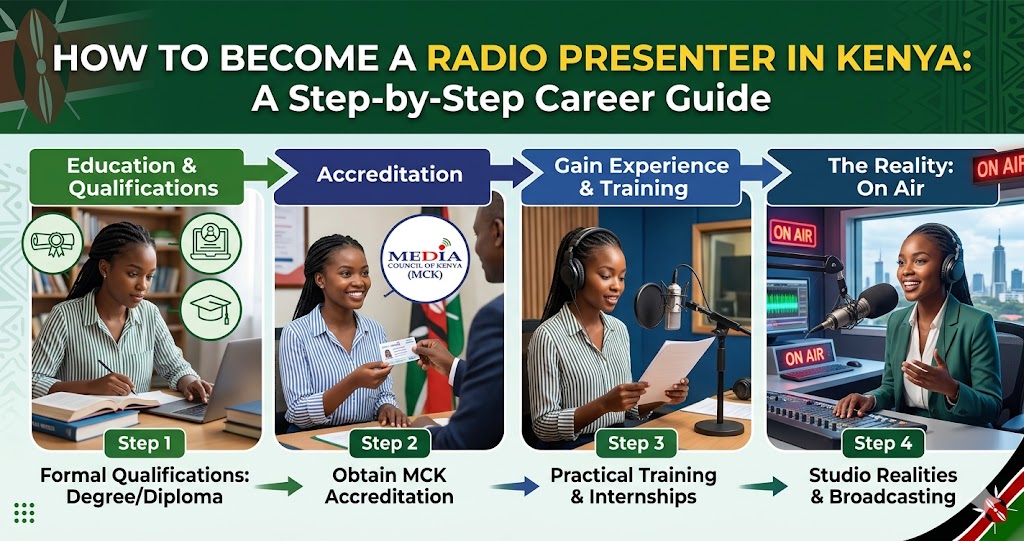
I want to write this guide the way I wish someone had written it for the people I have watched go into broadcasting in Kenya — some of whom now host shows you have heard of, most of whom do not. The standard online version of this guide tends to be a bullet list that starts with "have a great voice" and ends with "send your demo to stations." It is not wrong, exactly. It is just thin enough that anyone who actually follows it will discover, somewhere around month six, that they have been planning for a job they did not yet understand.
So here is the longer version, with the parts that the listicles leave out.
Start with the formal qualification, the Media Council Act No. 46 of 2013 insists on it.
This is the change that the older guides often miss. Until about a decade ago, you could plausibly walk into a Kenyan radio station with a strong voice, a good demo, and a bit of luck, and find yourself behind a microphone. That route is not closed, but the legal architecture around it has tightened. The Media Council of Kenya, established under the Media Council Act No. 46 of 2013, now accredits journalists and media practitioners, and the Council's definition of "media practitioner" explicitly names presenters, talk-show hosts, anchors, and continuity announcers. To be formally accredited — which most established stations now expect of their on-air staff — you need a degree or diploma in Journalism or Communication from a recognised training institution, a portfolio of work, and a completed Media Council ethics training course. The accreditation card costs KSh 2,000 per annum for local journalists, and it expires on the 31st of December each year regardless of when you got it. The fee is the same throughout the year, so it is cheaper, in effect, to apply early.
You do not strictly need to be accredited to speak into a microphone. You do need it to work as a recognised media practitioner at most of the stations you have heard of, and to access the press conferences and official events that the job involves.
Where to study, and what the actual gates look like.
The shortest credible route to the accreditation card is the Kenya Institute of Mass Communication — KIMC — on Uholo Road, off Mombasa Road, in Nairobi. It was established in 1961 as the Voice of Kenya Training School and is the institution that has trained the bulk of Kenyan broadcasters since. Its TV and Radio Production department was established in 1969. KIMC has one intake a year, in September, with course offerings advertised in the daily newspapers in June. Diploma courses require a KCSE mean grade of C plain, with at least C plain in English and Kiswahili. Certificate courses require a mean grade of C-. Diplomas take three years; certificates take one. If you want the diploma but only have certificate-level grades, you can do the certificate first and upgrade afterwards with one year of media experience — that route exists deliberately.
KIMC is not the only path. The universities that offer Bachelor's degrees in Journalism or Communication — Daystar, Kenyatta, Maseno, the University of Nairobi, Moi — generally require a KCSE mean grade of C+ for direct entry. There are also private colleges of varying quality, including the Andrew Crawford Media Training School and the East African School of Media Studies. The Media Council's accreditation language is "from a recognised training institution," which is a category that the Council itself maintains. Before you pay tuition anywhere, check that the institution is on that list.
Two practical points the marketing material rarely mentions. First, the entry grades for KIMC are not as high as for the university route, which makes the institute disproportionately important as a pathway for capable students whose KCSE results were uneven. Second, the institute's annual intake is a hard deadline — miss the September window and you wait a full year. Apply in good time.
The internship year is the real selection process.
Every diploma and degree programme will require an industrial attachment, which in Kenyan broadcasting parlance is called the "attachment" or sometimes simply "the internship." This is where the actual hiring happens. The Media Council issues student press cards specifically for fourth-year undergraduates and third-year diploma students proceeding to attachment, which tells you how central the council considers this step to be.
Do not romanticise this period. It is, in most cases, unpaid or paid only with a small stipend. You will be expected to arrive early, work late, run the panel for senior presenters, write scripts you will not be credited for, and field a great deal of work that has nothing to do with the on-air career you came in chasing. The students who convert their attachments into actual presenter slots are not, in my observation, the most talented ones. They are the ones who became indispensable to a producer or a senior presenter — who could run the desk reliably, who knew where the music library was, who answered the phone at six in the morning. Talent is one input among several. Reliability is the one that gets remembered when a slot opens.
Vernacular fluency is the single biggest career multiplier nobody mentions in English-language guides.
Since the opening of FM frequencies in 1995 and the arrival of private vernacular stations from the late 1990s onwards, the Kenyan radio market has fragmented into roughly four overlapping segments: KBC's public-service stations; the English-language commercial stations (Capital, Kiss, Hot 96, and so on); the Swahili-language commercial giants (Radio Citizen, Radio Jambo, Milele); and the vernacular stations broadcasting in Kikuyu, Luo, Kamba, Luhya, Kalenjin, and other languages, often run as networks by groups like Royal Media Services. The English-language segment is small and over-supplied with applicants. The vernacular segment is much larger and chronically short of presenters who can hold a three-hour show entirely in their mother tongue, including the idioms and the cultural references the audience expects. If you grew up bilingual or trilingual and can present fluently in a Kenyan language other than English or Swahili, you are far more employable than your English-only equivalent. Many of the most stable presenter careers in this country have been built in vernacular radio, where the competition is less brutal and the audiences are intensely loyal.
Build a portfolio before you need one.
The Media Council asks for "a portfolio of work done either in Print or Broadcast" as part of accreditation, and stations ask for the equivalent — a demo — when you apply. The mistake people make is treating the portfolio as something they will produce when they need it. By the time you need it, you are already late. Start recording while you are still in school. Set up a podcast. Volunteer at the campus radio station. Approach a community radio station — there are dozens, licensed by the Communications Authority of Kenya — and offer to fill an unpopular off-peak slot. Community radio is the part of the Kenyan broadcasting landscape that most readily admits a complete beginner, and it teaches you the parts of the job that classrooms cannot teach: live panel operation, dealing with callers, recovering from mistakes on air, filling unexpected silence.
Two minutes of good clean tape from a real broadcast is worth more in a demo than thirty minutes of polished classroom exercise. Hiring producers know the difference.
About the money — the unflattering truth.
You may have read that some Kenyan radio presenters earn KSh 1 million a month or more. This is occasionally true, and it refers to a handful of marquee names — the long-tenured morning hosts on the biggest commercial stations, the Maina Kagenis and Mwalimu King'ang'is of the industry. It is not representative of the field, in the same way that what a Premier League striker earns is not representative of professional football.
There is no publicly available comprehensive salary survey for Kenyan radio presenters. Anecdotally, entry-level presenters at smaller commercial and community stations earn very modest amounts; mid-career presenters at mid-tier stations earn comfortable middle-class salaries; and the very top of the field earns what the listicles report, plus brand endorsements and event-hosting fees that often exceed the radio salary itself. The distribution is steep. Plan your finances assuming you are entering the bottom of it.
The part most guides skip entirely: this is a profession with an ongoing licence cost.
Accreditation is annual. The card expires every 31st of December. The KSh 2,000 is not a one-time fee, and you will need to renew it for as long as you are working in the field. The Council does not prorate; if you apply in November you pay the same as someone who applied in February. Stations sometimes cover this cost for staff presenters; many do not. Freelancers and casuals almost always cover it themselves.
There is also a strong professional case — beyond the legal one — for completing the Media Council's ethics training course thoroughly rather than as a formality. Kenyan broadcasting has had genuine crises around irresponsible on-air speech, most painfully during the post-election violence of 2007–08, and the regulators are now actively monitoring on-air content. A presenter who does not understand the ethics framework is one bad on-air moment away from being suspended or struck off.
A note on the digital side, and on what I do not know.
The honest answer to "should I just start a podcast instead?" is that nobody yet knows where the balance is going to settle. Traditional terrestrial radio in Kenya remains enormous, particularly in rural areas where it is still the dominant medium. But streaming, podcasting, and the radio-on-Instagram-Live phenomenon are real and growing, and several Kenyan presenters have built audiences online that the established stations have then hired. If your goal is specifically to work for a major commercial or public station, the school-attachment-accreditation route is still the most reliable. If your goal is to be a broadcaster in the broader sense — someone with a listening audience and a voice people return for — the digital route is now genuinely viable, and the gatekeeping is genuinely lighter. I would not bet against people building entire careers without ever touching a traditional station. I would also not advise abandoning the traditional route on that basis, because the audiences and the institutional credibility are still concentrated there.
One last thing.
The single most consistent observation I would make about the presenters I have watched succeed in Kenyan radio is this: they kept showing up after the first three or four rejections. Not after the first one — most people do that. After the third, the fourth, the demo that no station replied to, the attachment that did not turn into a job, the year spent on a graveyard slot at a community station while their classmates moved on. The voice can be trained. The grade-point average can be supplemented. The card can be paid for. What cannot be substituted is the willingness to be unimpressive for a couple of years while you become useful to somebody.
If you have that, the door is open. It is narrower than the guides suggest, and the room behind it is more crowded. But it is open, and there are more Kenyans broadcasting to more Kenyans, in more languages, on more platforms, than at any point in the country's history. That part, at least, is not propaganda. That part is just the room you are walking into.
Ready to listen? Stream live Kenyan radio stations free — no app required.
Browse All Kenyan Radio Stations →