How Kenyan Radio Stations Make Money: A Look at the Business Behind the Mic

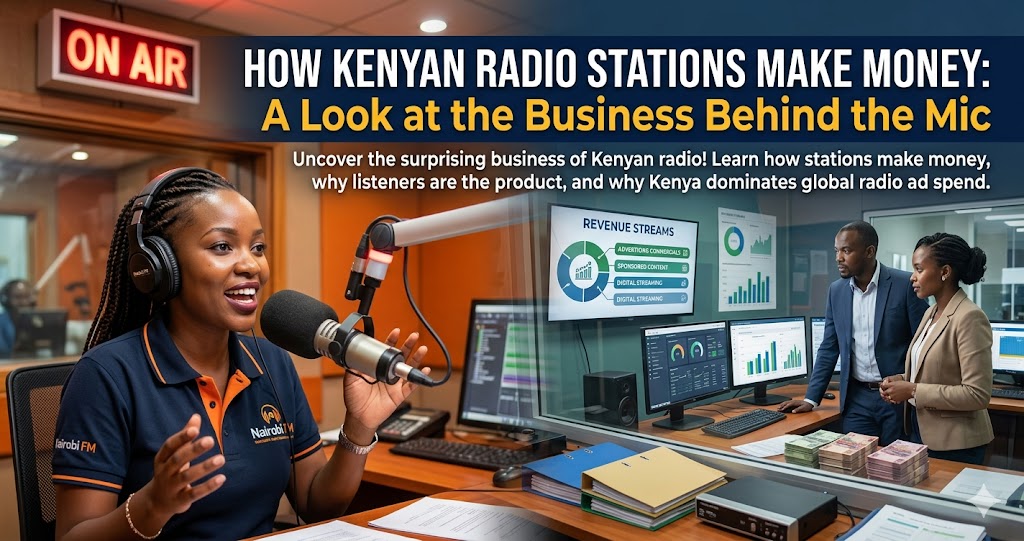
Let me be clear about what this is. It is not a balance sheet. The companies that own Kenya's big radio stations are private, or state-shielded, and they do not open their books to people like me. What follows is an attempt to trace the money — where it comes from, who stands between the listener and the till, and who, at the end of the chain, actually gets paid. I have used figures I could verify. Where the figures fight each other, I have said so rather than pick the tidy one. The honest answer to "how does Kenyan radio make money" turns out to be more interesting, and more uncomfortable, than the question sounds.
The thing you are actually buying when you turn on the radio
Start with the uncomfortable truth at the centre of the whole business: radio is free to the listener, and that is the point. You are not the customer. You are the product. The matatu passenger half-listening to Radio Jambo on the morning commute, the mama mboga with Inooro FM on behind the stall — they are not buying anything. They are the inventory. What the station sells is them — their ears, their attention, sliced into demographics and time slots and sold on to whoever wants to reach them.
And the demand for those ears is enormous. This is the part outsiders find genuinely hard to believe. Radio is the number two advertising channel in Kenya, and at one point it commanded over 22 percent of the country's total ad spend, with more than 8 billion shillings poured into it in a single year. Globally, the picture is almost comic in its disproportion: a PwC analysis found that Kenya — a small economy by world standards — runs the largest radio advertising market in the Middle East and Africa region, and one of the largest on earth. The same report projected Kenya generating more radio ad revenue than Italy. Italy. A country with an economy more than twenty times the size.
Why? One word, and I will keep coming back to it: reach. Over 90 percent of Kenyan households own a radio. Most of the population is rural; most of the rural population is past the reach of the newspaper and was, for a long time, past the reach of reliable internet. Every feature phone has an FM tuner built in. If you are a soap company or a bank or a political party and you need to reach the whole of Kenya — not the Twitter Kenya, the whole of it — radio is not one option. For a long time it was the only one.
Spot advertising: the bread, and it is dry bread
So the first and biggest revenue stream is the obvious one — the advert. The thirty-second spot. The fifteen-second spot. And here is where the verified numbers get genuinely useful, because they tell you something about the shape of the business.
A thirty-second spot during morning drive time on a big Swahili station can run around 50,000 shillings. But the floor is far lower — sources put a thirty-second ad across the wider market anywhere from 5,000 shillings on a small station upward, and one mid-tier broadcaster's published card runs from roughly 14,000 shillings for a fifteen-second spot to 44,000 for a full minute. That spread — 5,000 to 50,000 for essentially the same thirty seconds of air — is the entire economics of Kenyan radio compressed into one number range. You are not paying for the airtime. The airtime is free; it is just electromagnetic radiation. You are paying for whose ears, and when.
This is why drive time exists as a concept. Prime time — roughly 6 to 10 in the morning, and 3 to 8 in the evening — is when the matatus are full and the kitchens are busy, and a station can charge a premium because that is when the inventory is richest. The mid-morning hours are, in the trade's own honest phrase, "filler." Cheaper ears. Fewer of them.
Now — a caveat I will not skip, because skipping it would flatter the industry. The currency of all this is the audience survey: the ratings that say Station X reaches 5.2 million people weekly, or holds 22 percent of the Nairobi market. Stations live and die by those numbers, and stations also have every incentive in the world to dispute the ones they don't like and trumpet the ones they do. I report the figures here — Radio Jambo's claimed 5.2 million weekly reach, its 22 percent Nairobi share — because they are the figures in circulation. I do not report them as gospel. In a business where the rate card is built on the rating, the rating is never a neutral fact. It is a negotiating position wearing the costume of a measurement.
The part the rate card doesn't show: sponsorship, "live reads," and the blurred line
Here is what took me longest to understand, and what I think most listeners never quite see. The spot advert is the least lucrative-feeling part of the modern Kenyan radio business, because the spot advert is honest. It announces itself. You hear the jingle, you know you are being sold to, your brain puts up its small defence.
So the industry moved the money to where the defence is down.
Listen to a Kenyan morning show closely and count the things that are not, technically, "adverts" but are absolutely being paid for. The sponsored segment — the traffic update "brought to you by." The competition, the giveaway, where the prize is the sponsor and the sponsor's name is repeated forty times in an hour as content, not as a break. The "live read," where the presenter — the trusted voice, the friend in your kitchen — personally vouches for a product in their own warm idiom, in the local language, between two songs. Industry write-ups put sponsorship income for a popular show at upward of a million shillings a month, and that is plausible precisely because sponsorship sells something the spot cannot: it sells the presenter's credibility.
I want to call this what it is, because the industry's own marketing language won't. The vernacular stations' great commercial asset — the thing the trade press celebrates openly — is that an ad in Kikuyu or Kalenjin or Dholuo, in local idiom, voiced by a trusted local presenter, is "more memorable." Read that again. The same intimacy that makes vernacular radio a genuine community lifeline — local news, health information, the language people think in — is also, from the sales department's chair, a premium product. Trust converts to revenue. The warmer the voice, the higher the rate. I do not think that is sinister, exactly. But I think it is worth naming plainly, because nobody on the sales side ever will.
Then there is the off-air money, which is real and growing: roadshows, branded activations, station-hosted concerts and festivals, the radio brand walking out of the studio and into a marketplace for three days with a sponsor's banner. The station is no longer just selling air. It is renting out its name.
Who owns the microphone
You cannot understand the money without understanding the ownership, and the ownership is startlingly concentrated. Kenya has — depending on whose count and which year — somewhere north of 200 licensed radio stations. The Communications Authority has cited 227, with 172 of them commercial. That sounds like a vibrant, plural, competitive market.
It mostly isn't. The great majority of those stations sit inside a handful of groups: Royal Media Services, Radio Africa Group, the Standard Group, Mediamax, Nation Media Group, and the state's own KBC. Royal Media alone runs around thirteen radio stations. So when an advertiser "shops around" between Inooro and Ramogi and Egesa and Hot 96 and Radio Jambo, they are, more often than not, shopping inside one company's portfolio. The vernacular diversity you hear on the dial — a station for nearly every language — is, on the business side, frequently a single owner's product line, each station a different door into a different ethnic audience, all the rent flowing back to the same landlord.
That is the quiet engine of the whole industry. Not many competitors fighting. A few large houses, each holding a fan of stations, each station a separately-branded net thrown over a separately-defined slice of the country.
The other money: ringback tones, and a story that turns dark
I'll close on a revenue stream that isn't strictly the radio station's, but that nobody honest can leave out of "the business behind the mic" — because it is where Kenyan audio money becomes a genuine scandal, and where the gap between who plays the music and who is paid for it stops being abstract.
Skiza. Safaricom's ringback tone service — you dial a code, and instead of the standard brrr your callers hear a song. Launched in 2009. And here the verified numbers are extraordinary: the platform has been estimated to gross in the region of 7.58 billion shillings a year, charging subscribers roughly 1.50 shillings per tune per day. Tiny coin. Millions of phones. Court documents have referenced something like 200 million shillings disbursed monthly, with over 21,000 artistes registered.
Now follow the cut, because the cut is the whole story. When Skiza began in 2009, the artiste — the person who actually made the music — received 7.5 percent. Safaricom and the chain of middlemen kept the rest. For years the split that circulated put the telco retaining around 54 percent, with the government taking excise duty and VAT, and the artiste left splitting a thin 15 percent slice with the intermediaries — the Premium Rate Service Providers — who sit between the musician and the platform. Years of pressure, a 2022 Copyright Act amendment signed by then-President Kenyatta, and an incremental series of Safaricom revisions pushed the artiste's share upward — to 30 percent, then 40 percent, with the law setting a target of 52 percent.
And yet. In 2023 the comedian and creator Eddie Butita said publicly that one of his tracks had earned him 86 shillings. The entertainer Mulamwah reported 31. Eighty-six shillings. Thirty-one. From a platform grossing billions. The gospel singer Eunice Njeri once wrote an open letter to Safaricom saying the logs showed her music billing tens of millions while she struggled to make ends meet. As of late 2025 the whole apparatus was still in court — payments halted, producers suing, the revenue split itself unresolved.
I include all of this because the title of this piece promised the business behind the mic, and this is the business behind the mic, followed to its end. A song plays. Somewhere a fraction of a shilling moves. It moves through a telco, through a service provider, through a collecting society, through excise duty and withholding tax — and the musician at the start of the chain, the reason any of it has value at all, opens the envelope and finds 31 shillings.
So when people ask me how Kenyan radio makes money, I have stopped giving the tidy answer about adverts and sponsorship and reach. The fuller answer is this: Kenyan radio is one of the most lucrative attention markets on the planet relative to the size of the economy, and it runs on a substance — the listener's trust, the presenter's warmth, the song someone wrote — that the people who generate it are very often the last and the least to be paid for it. The mic is the cheap part. Everything valuable is happening on either side of it.
That is not a conclusion that resolves. I don't think it should. The business is still being fought over, in courtrooms and rate-card negotiations, right now, while you read this. Ask me again in a year.
Ready to listen? Stream live Kenyan radio stations free — no app required.
Browse All Kenyan Radio Stations →