A Brief History of Radio Broadcasting in Kenya: From Colonial Era to Digital Streaming

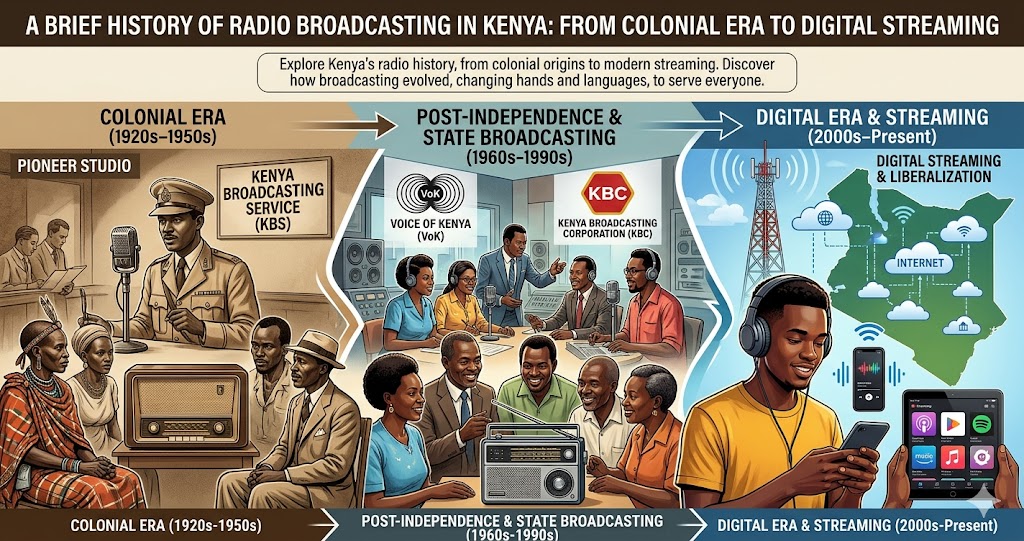
I should say at the outset what this is and isn't. It is not a comprehensive media history — those exist, written by people who spent years in archives I have only read about. It is a walk through the moments that, to my mind, matter most: the points where radio in this country changed hands, changed languages, or changed who it was actually for. That last question is the one I keep returning to. Radio in Kenya has almost always belonged to someone. The interesting history is the slow, contested, still-unfinished business of it coming to belong to everyone.
The settler's wireless, 1927
Radio arrived in Kenya in 1927, and it did not arrive for Kenyans. The East African Broadcasting Corporation began transmitting that year, mostly relaying BBC news, and by 1928 there were regular English-language broadcasts. The audience was the white settler community — people who, as one account puts it, monitored news from their home countries, listening across an enormous distance to a Britain they still thought of as home. Asian listeners were served too, somewhat later. Africans were not the audience. They were, at most, in the room.
I find it useful to sit with that for a moment, because it sets the pattern. The technology was never neutral. A loudspeaker in a Nairobi settler's sitting room in 1929 was an instrument of belonging — it told a small minority that they were connected, modern, still part of an empire. The fact that radio waves are physically indifferent to who owns the receiver is the loophole that the rest of this story slowly, painfully exploits.
In 1931 the colonial government handed broadcasting to the Imperial International Communication Company on a 25-year arrangement — a private contractor running a public-shaped service, which is a tension that, frankly, never really goes away in this story. It keeps coming back. Hold that thought.
The Emergency, and radio in the mother tongues, 1952–53
Here is the bitter irony at the centre of Kenyan radio history, and I do not think it can be stated too plainly. The first sustained broadcasting for Africans, in African languages, began in 1953 — and it began because the colonial state had declared a State of Emergency in October 1952 to crush the Mau Mau uprising. The colonisers discovered the African listener at the exact moment they needed to broadcast propaganda at him.
So the mother tongues entered the airwaves not as a gift but as a weapon. That is the uncomfortable founding fact. And yet — and this is the part historians of African radio have argued, and I think they are right — the thing did not stay obedient. A medium built for propaganda turned out to be, in the scholars' phrase, slippery; it kept producing publics its makers had not authorised. You hand people a voice in their own language, even cynically, even as a tool of counter-insurgency, and you have handed them something you cannot fully take back. The colonial broadcasters of 1953 were, without meaning to, training the audience that would outlive them.
A commission sat in 1954 to consider broadcasting's future. By 1959 the Kenya Broadcasting Service had been established. The wind of change — Macmillan's phrase, 1960 — was already blowing, and the colonial authorities knew it. They had used radio against the Mau Mau; now they were afraid the same mouthpiece could be turned against them. So they tightened censorship even as independence approached, which is the behaviour of a power that understands exactly what it built.
Independence, and a nationalisation that borrowed colonial moves, 1961–1964
This stretch is genuinely tangled, and I will not pretend the chronology is tidy, because it isn't. In 1961 the private Kenya Broadcasting Corporation was formed to succeed the government-controlled KBS — the outgoing colonial administration apparently nervous about handing a state broadcaster directly to Kenya's incoming leadership. Television launched around 1962–63, famously transmitting at first from a farmhouse in Limuru with a range of only about fifteen miles. (I love that detail. The whole future of Kenyan broadcasting, beaming out of a farmhouse, reaching the next ridge and not much further.)
Then independence, December 1963. And in June 1964 the new government nationalised the broadcaster, renaming it the Voice of Kenya, folding it into the Ministry of Information and Broadcasting.
Now — here is where I want to be careful, and honest. The easy story is liberation: the people's broadcaster, reclaimed. But scholars of this period have made a sharper, less comfortable argument, and I think it has to be faced. The independent government, in nationalising broadcasting, used what one writer calls "colonial moves." It had learned the lesson the colonisers taught: a carefully controlled broadcasting service is superb for mobilising citizens toward the government's interests. Jomo Kenyatta and the men around him were, by every account, acutely aware of the power of media. So the Voice of Kenya became the voice of the state — and stayed that way for a long time. The KIMC, the country's first journalism school, was founded in 1963 to train the people who would staff it.
I call this independence-with-an-asterisk, and I want the asterisk to stay visible. Ownership had moved from London to Nairobi. Whether it had moved any closer to the listener is a different question, and the honest answer is: not yet.
The monopoly, and the long quiet
For roughly three decades after independence, this is the simple, heavy fact: one broadcaster. The Voice of Kenya, reverted to the name Kenya Broadcasting Corporation by Parliament in 1989, was effectively it. Radio was the most popular and accessible medium in the country, reaching further into rural Kenya than any newspaper ever could — and ownership sat, concentrated, in government hands. The Central Service did broadcast in vernacular languages, with hourly slots parcelled out to different communities through the day. But the slots were the state's to allocate, the editorial line the state's to set.
I want to resist writing this era as simply a void, because that would be lazy and probably unfair. People listened. People loved their programmes — there are Kenyans who have followed the same KBC shows for fifty years and more, and that devotion is real, not false consciousness. But as a democratic infrastructure, the monopoly years were a long quiet. One voice, broadcasting nationally, answerable upward rather than outward.
The airwaves crack open, 1990–1996
And then, in the early 1990s, everything that had been held shut began to give way at once — and not by coincidence. This is the same window as the repeal of Section 2A, the same second-liberation pressure that was forcing multiparty politics into being. Media liberalisation was not a separate gift handed down; it was prised loose by the same hands.
The Kenya Television Network had already broken the television monopoly in 1990. For radio the technical turning point came in 1995, when FM frequencies were opened — broadcasting in Kenya having run on AM until then. KBC's own subsidiary, Metro FM, was first onto the new FM band, which tells you something quietly amusing about how these transitions go: the incumbent gets there first even into the era meant to end its dominance.
But 1996 is the year I would underline. Capital FM launched — the first privately owned station broadcasting on FM frequencies in Kenya, an English-language station owned by the businessman Chris Kirubi, aimed squarely at an urban, upmarket audience. A genuinely private radio voice, at last. The catch — and there is always a catch in this story, you will have noticed the pattern by now — is who it was for. Liberalisation's first instinct was the same as the colonial wireless of 1927: serve the elite first. The medium had been freed from the state and promptly handed to the market, and the market's opening question was the old question — who can pay?
The mother tongue comes back — this time as the people's, around 1998–2000
Then came the station that, for me, is the real hinge of the whole modern story: Kameme FM, Kenya's first vernacular FM station, broadcasting in Kikuyu under the slogan Kayũ ka Mũingĩ — "Voice of the People."
I have to flag a genuine discrepancy here rather than smooth it over, because the sources do not agree and I would rather you knew that. Several scholarly accounts date Kameme's establishment to 1998; other widely cited histories, and the station's own telling, place the launch in early 2000. I cannot resolve it from where I sit, and I will not pretend I can. What is not in dispute is the consequence. KBC, sensing the competition, quickly stood up its own Kikuyu station, Coro FM. And then the dam broke — dozens of vernacular stations across the country, each in a different language, each addressing a community the national broadcaster had only ever given an hourly slot.
There is a heavier sub-plot worth naming. Kameme reportedly took more than two years to roll out frequencies beyond Nairobi, and one explanation offered is political: the Moi government's wariness that a Kikuyu-language station broadcasting freely into Central Kenya could become a vehicle for resentment against the regime. So even in the liberalised era, the State of Emergency logic flickered back — the old fear that radio in the mother tongue is a power that escapes its licensor. That fear was not paranoid. It was, if you read this history honestly, simply correct.
Vernacular radio is the moment the medium finally reached the listener it had ignored since 1927 — the rural Kenyan, the grandmother in Kieni, the matatu driver who wants the news in the language he thinks in. It is also, and I will not pretend otherwise, the moment Kenyan radio became more intimate and more dangerous at the same time. The same vernacular intimacy that lets a station discuss local crop prices and clinic queues with real warmth can also, as the country learned painfully around the 2007–08 post-election violence, carry the language of division straight into the ear. I leave that there, unresolved, because it is unresolved.
The digital present, and an unfinished question
Less than ten radio stations in Kenya in 1999. Over a hundred within a few years. By 2011, around 148. The graph just keeps climbing, and today a growing number of young Kenyans never touch a physical radio set at all — they receive broadcasts on their phones, stream over the internet, follow stations as much through social feeds and podcasts as through the FM dial. The country's switch from analogue to digital broadcasting carried this further still.
Has the loop closed, then? Does radio finally belong to everyone?
I do not think the honest answer is yes, and I am not going to pretend it is for the sake of a satisfying ending. The colonial wireless asked who can be trusted to listen. Post-independence radio asked who does the broadcaster answer to. The FM market asked who can pay. The digital era has its own version of the old question, and it is roughly this: who can afford the data, who owns the platform, and whose voice does the algorithm carry furthest. The contractor of 1931 has not really gone away. The gatekeeper just keeps changing costume.
A century on from that first settler broadcast — and Kenyan radio is louder, freer, and more plural than it has ever been. That is a real achievement and the second-liberation generation paid for it. But the medium has never once in its history simply belonged to its listeners without someone standing between them and it. Maybe that is the nature of broadcasting. Or maybe it is just the part of the work that is not finished. I know which of those I would rather believe, and I know which one the evidence, so far, supports.
It is not yet uhuru on the airwaves. It is closer than it was. That will have to do for an ending, because the story has not given us a better one yet.
Ready to listen? Stream live Kenyan radio stations free — no app required.
Browse All Kenyan Radio Stations →