The Story of Radio Citizen: How a Kiswahili Station Became Kenya's Most Listened-To

The honest version of how Radio Citizen became Kenya's most listened-to radio station has very little to do with programming and almost everything to do with a contempt-of-court proceeding in the 1990s. The station exists because one Kenyan businessman, having been refused a broadcasting licence by the Moi government year after year, took the cabinet minister and the attorney general to court, won, was ignored, and then took both of them to court again — for contempt — and got each of them sentenced to six months in jail. President Moi summoned him to State House. "Why do you want to take my ministers to jail?" the president reportedly asked. The businessman's answer, according to his own later account, was that they had been ordered to give him a licence and had refused, and that was that. The licence was eventually issued. Citizen TV launched in 1999. Radio Citizen launched alongside it. Royal Media Services was born.
The businessman was Samuel Kamau Macharia, and almost nothing else about Kenyan private broadcasting makes sense unless you understand that he existed as a real person willing to do this. Every other story about Citizen — the Kiswahili strategy, the network of fourteen radio stations across the country, the dominant share of national listenership now confirmed in the Q1 2026 GeoPoll data — is downstream of that single decision to fight the licensing system through the courts until it broke.
Quick answer: why Radio Citizen is Kenya's most listened-to station
Radio Citizen is Kenya's most listened-to radio station, reaching 64.7% of radio listeners in GeoPoll's Q1 2026 audience data. Three things explain its dominance: the court battle that forced its 1999 licence into existence; a Kiswahili-first programming strategy in a looser, more conversational register than the state broadcaster used; and its place at the centre of a 14-station Royal Media Services network that covers almost every major Kenyan language community through a single advertising relationship.
The man before the station: Samuel Kamau Macharia
Macharia was born in 1942 in Ndakaini village, Murang'a County. His mother died when he was five. The family moved to Arusha looking for work and didn't find it, and the young Macharia spent years herding cattle with Maasai boys before returning to Kenya for primary school. He worked his way through university in the United States, eventually graduating from Seattle Pacific and Stanford, and came back to Kenya to build a tissue-paper manufacturing business called Madhupaper International, whose Rosy brand became, by the mid-1980s, the only domestic tissue-paper brand in the country. The company employed about three hundred people. It was placed under receivership by Kenya Commercial Bank on the 25th of October 1985. The political details of that receivership are not entirely public, but the pattern fits what was happening to a lot of independent businesspeople during the Moi era.
It is worth dwelling on this because the founding of Radio Citizen is sometimes told as a media story, and it is more accurately a business-survival story. By the early 1990s Macharia had lost a manufacturing empire and was trying to break into broadcasting — a sector the state controlled completely through the Kenya Broadcasting Corporation. The licensing battle that followed lasted years. The current RMS website claims a 1996 founding date for the company; every other reliable source, including Macharia's own public accounts of the period, places the actual on-air launch in 1999, after the contempt proceedings had finally forced the government to grant the licence. The discrepancy is small but worth noting — the company that today describes itself as "established in 1996" was, in practice, fighting in court until 1999 for the right to broadcast at all.
The Kiswahili bet that built Radio Citizen
When Radio Citizen finally went on air, the strategy was unusual in a way that has been obscured by hindsight. Most of the new private FM stations launching in Kenya in the late 1990s — Kiss 100 in 1999, Classic 105 the following year — were aimed at the English-speaking urban middle class, because that was where the advertising money lived. The Swahili audience was bigger but commercially less developed. KBC's Swahili service existed, but it was the national broadcaster, with all the staid presentational habits of a state-owned institution.
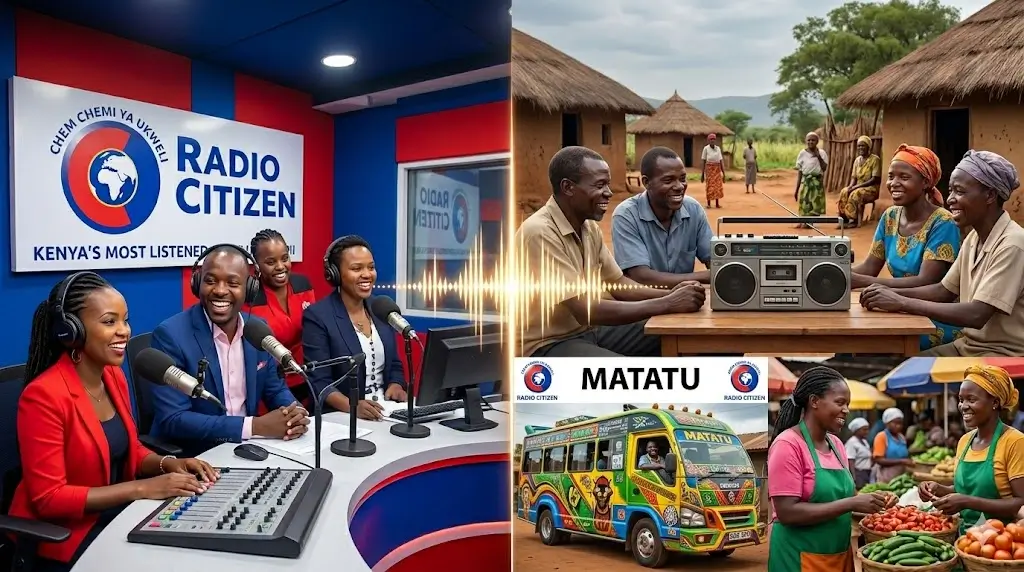
Citizen's bet was to broadcast exclusively in Kiswahili and to do so in a register the national broadcaster did not use — looser, more conversational, more rooted in the rhythms of how Kenyans actually spoke to each other in markets and matatus and the back rooms of mama mboga stalls. The tagline became Chem Chemi ya Ukweli — the Source of Truth — and the morning show was called Pambazuka, the Kiswahili word for "Arise." The format was straightforward: news, talk, listener calls, African music, a programming line-up that the RMS website still describes as "designed to inform the listeners on most aspects of life including entertainment and news," covering health, the economy, education, the environment, and social issues. The unstated argument was that this was what a national radio station should sound like in a country whose actual national language was Kiswahili.
The bet paid off slowly and then quickly. By the mid-2010s, Radio Citizen was consistently ranked first in national listenership surveys by Ipsos and GeoPoll. The RMS website now claims the company's radio network reaches roughly 80% of Kenya's population — a figure that requires the entire fourteen-station portfolio to make literally true, but which is plausible at the network level.
The Royal Media Services network: Radio Citizen's real advantage
This is the second part of the answer that the popular framing tends to miss. Radio Citizen is not, by itself, the explanation for RMS's dominance. The explanation is that Citizen sits at the centre of an integrated portfolio of vernacular stations that together cover almost every major language community in the country:
| RMS station | Language community served |
|---|---|
| Radio Citizen | National Kiswahili |
| Inooro FM | Kikuyu |
| Ramogi FM | Dholuo |
| Musyi FM | Kamba |
| Chamgei FM | Kalenjin |
| Muuga FM | Meru |
| Egesa FM | Gusii |
| Bahari FM | Coastal Swahili |
| Mulembe FM & Sulwe FM | Luhya sub-groups |
| Wimwaro FM | Embu |
| Hot 96 | English-speaking urban audience |
| Vuuka FM | Youth-skewing audience |
What this means in commercial terms is that an advertiser placing a national campaign through RMS reaches the Kikuyu housewife in Murang'a, the Luo boda boda rider in Kisumu, the Kamba shopkeeper in Machakos, the Kalenjin farmer in Eldoret, and the coastal mama mboga in Mombasa, in each case in the language they actually use at home, through a single sales relationship. No other Kenyan media group has built anything quite like it. Standard Group has Radio Maisha. Mediamax has Milele and a small portfolio. Nation Media Group has been in and out of broadcasting in various forms. Radio Africa Group has Classic and Kiss and Radio Jambo, but does not have the vernacular depth. RMS, more or less by itself, captures the linguistic structure of the Kenyan listening market.
The 2018 exodus and what it revealed
Radio Citizen's dominance has not gone unchallenged. The most serious challenge came in 2018, when a group of senior RMS talent — including the head of Citizen Radio, Joyce wa Gituro, who had been hosting Pambazuka, along with Francis Luchivya and Jacky Nyaminde ("Wilbroda") from sister station Radio Jambo — defected to Milele FM. Milele was at the time owned by Mediamax, majority-controlled by then-Deputy President William Ruto, and was investing aggressively to build a credible Swahili-language alternative to Citizen. The talent grab worked, at least in some measurements. By the Media Council of Kenya's State of Media Survey for 2024, Milele FM had risen to #1 in national listenership at 14% share, with Citizen and Radio Maisha both having declined materially. For one survey cycle, the dominance was genuinely broken.
The recovery, when it came, was quick. GeoPoll's Audience Measurement data for Q1 2026 puts Citizen back at the top of national radio reach:
| Station | Q1 2026 national reach |
|---|---|
| Radio Citizen | 64.7% |
| Radio Jambo | 59.6% |
| Classic 105 | 58.4% |
| Radio Maisha | 56.6% |
| Milele FM | 49.2% |
The gap between Citizen and the chasing pack is real but not enormous, and the precise ordering shifts from survey to survey depending on methodology — but the broad picture is that Citizen has reclaimed its position.
The breakfast loss: where Radio Citizen slipped
What Citizen has not reclaimed is its longstanding leadership of the most commercially valuable slot in Kenyan radio. The Q1 2026 GeoPoll data, written by Frankline Kibuacha and published in April, shows Classic 105 leading the weekday breakfast slot (6:00 to 9:00 AM) with 18.8% of top-ten listening share, ahead of Citizen at 17.4%. Citizen still leads drive-time (20.4%) and evening (26.1%), but the breakfast crown — which the station has historically held — has gone, at least for this measurement period, to its English-language competitor. The gap is small. The pattern matters.
The current host of Pambazuka — Mike Mteule, per RMS's own social channels — is doing a competent job by all visible indicators, but is now working in a slot where Classic's Maina Kageni and Mwalimu King'ang'i have, after two decades of grinding, finally edged ahead in measured share. Whether Citizen takes the slot back in Q2, or whether Classic's breakfast win marks a genuine shift, is the open question hanging over the 2026 ratings cycle.
The honest summary: three reasons Radio Citizen dominates
The standard explanation for Radio Citizen's dominance is that it speaks the country's national language. This is true but insufficient. KBC's Swahili service has also been speaking the national language for sixty years, and nobody listens to it. The fuller explanation has three parts.
The first part is the licensing battle that brought the station into existence in 1999, which is genuinely the precondition for everything else. A station that does not exist cannot dominate, and Citizen would not have existed without Macharia's willingness to put two senior government officials in contempt of court.
The second part is the Kiswahili-first programming strategy and the Pambazuka-style morning show that pioneered a register of broadcast Kiswahili looser and more conversational than what KBC had offered.
The third part — the part the marketing brochures don't talk about and the listicles miss — is the network. Citizen is the flagship of an integrated fourteen-station system that captures most of the Kenyan listening market in most of its major languages. The competitor that wants to dethrone Citizen has to dethrone the whole RMS architecture, not just one station.
The 2024 Media Council wobble suggested the architecture is not invulnerable. The 2026 GeoPoll data suggests it has recovered, though without the breakfast leadership that used to come with it. What I would not bet against is the durability of the underlying structure. Radio Citizen was built in court by a man who lost a tissue-paper company and decided, with that loss, that he was going to own a piece of the broadcasting market or break the licensing system trying. The station that comes out of that origin story has, on the available evidence, the kind of corporate stubbornness that survives most things, including the occasional bad quarter.
What it has not survived yet, but will probably try to, is Classic 105 in the breakfast slot. That fight is the one to watch.
Frequently asked questions about Radio Citizen
Who owns Radio Citizen?
Radio Citizen is owned by Royal Media Services (RMS), founded by businessman Samuel Kamau Macharia. The station launched in 1999 alongside Citizen TV after Macharia won a years-long court battle for a broadcasting licence.
Is Radio Citizen the most listened-to radio station in Kenya?
Yes. GeoPoll's Q1 2026 audience data places Radio Citizen first in national reach at 64.7%, ahead of Radio Jambo, Classic 105, Radio Maisha and Milele FM — though Classic 105 narrowly leads the weekday breakfast slot.
What language does Radio Citizen broadcast in?
Radio Citizen broadcasts in Kiswahili, in a deliberately looser, more conversational register than the state broadcaster KBC. Its tagline is Chem Chemi ya Ukweli ("the Source of Truth").
What frequency is Radio Citizen in Nairobi?
Radio Citizen broadcasts on 106.7 FM in Nairobi, with additional frequencies nationwide. (Frequency added for reader reference; confirm regional frequencies on official channels.)
What is the Radio Citizen morning show?
The flagship morning show is Pambazuka ("Arise"), built around news, talk, listener calls and African music. Its current host, per RMS's social channels, is Mike Mteule.
How many radio stations does Royal Media Services own?
Radio Citizen sits at the centre of a 14-station RMS network that includes Inooro FM (Kikuyu), Ramogi FM (Dholuo), Musyi FM (Kamba), Chamgei FM (Kalenjin), Hot 96 (English urban) and others, covering almost every major Kenyan language community.
Explore more on Kenyan radio
For more on the stations in this story, see our guides to the best Kenyan radio stations for news and current affairs, why Classic 105 remains Kenya's favourite adult contemporary station, and the role of community radio stations in rural Kenya, or browse all Kenyan stations on radio.co.ke.
Ready to listen? Stream live Kenyan radio stations free — no app required.
Browse All Kenyan Radio Stations →