The Role of Community Radio Stations in Rural Kenya

The category most people miss when they talk about Kenyan radio is the one that, by law, cannot sell you an advertising slot. Community radio stations in rural Kenya — and in the country's urban informal settlements — make up a small, structurally distinct tier of broadcasting that does what the commercial giants cannot and will not. This is what they actually do, drawn from the verifiable record rather than the donor-report version.
Community radio in Kenya is its own licence category under the Kenya Information and Communications Act of 1998, separate from public broadcasting (which means KBC and only KBC), separate from commercial broadcasting (Royal Media Services, Radio Africa Group, Mediamax, Standard Group), and separate from subscription services. The Communications Authority recognises five broadcasting categories, and community broadcasting is the one tier that is structurally barred from generating revenue through advertising in the way commercial FM stations do. The applicant entity has to be a registered community-based organisation, NGO, faith-based group, or society. Section 46C of the Act makes operating without the right licence a criminal matter — fine up to one million shillings, or imprisonment up to three years, or both. None of this is folklore. It is the statutory framework. It is also, in practice, the reason community radio in this country looks the way it does.
I want to write about what these stations actually do — not the donor-report version, where every community radio is "amplifying voices" and "fostering inclusion," but the verifiable version, drawn from the eleven or so community stations the sector currently runs and the academic literature that has actually documented them.
What is community radio in Kenya? A quick answer
Community radio in Kenya is a non-commercial broadcasting licence category created under the Kenya Information and Communications Act (1998). Run by registered community organisations, NGOs, faith groups, or societies, these stations are barred from funding themselves through advertising the way commercial FM stations do. There are roughly 11 community-based radio stations in Kenya. They broadcast in local languages to audiences the commercial market overlooks — rural farmers, pastoralists, and residents of urban informal settlements — covering agriculture, public health, local government, and civic information.
Where community radio in Kenya started: Homa Bay, 1982
The first community-based radio station in Kenya was established in Homa Bay in 1982, jointly initiated by the Kenyan government and UNESCO. This is the documented origin point. It predates the commercial FM liberalisation of 1995 by thirteen years. It predates Radio Citizen by seventeen. It is older than KTN. The fact that the sector's founding moment came from a multilateral development partnership rather than a commercial venture tells you something important: community radio in Kenya was, from the beginning, a tool of development practice before it was a piece of the broadcasting economy.
The numbers have stayed small. A piece in The Conversation in December 2025 by a Kenyan academic studying the sector puts the current count at eleven community-based radio stations — a number that has not grown much in two decades, despite the licensing framework being clear and the demand being demonstrable. The reason it has not grown is, mostly, money. A station that cannot run advertisements has to fund itself through grants, partnerships, member contributions, or government subsidy, and grant funding in this sector has tended to flow in waves tied to specific donor priorities — peace, public health, agricultural extension — rather than the steady commercial revenue that keeps the FM giants on air.
Radio Mang'elete: what rural community radio actually looks like
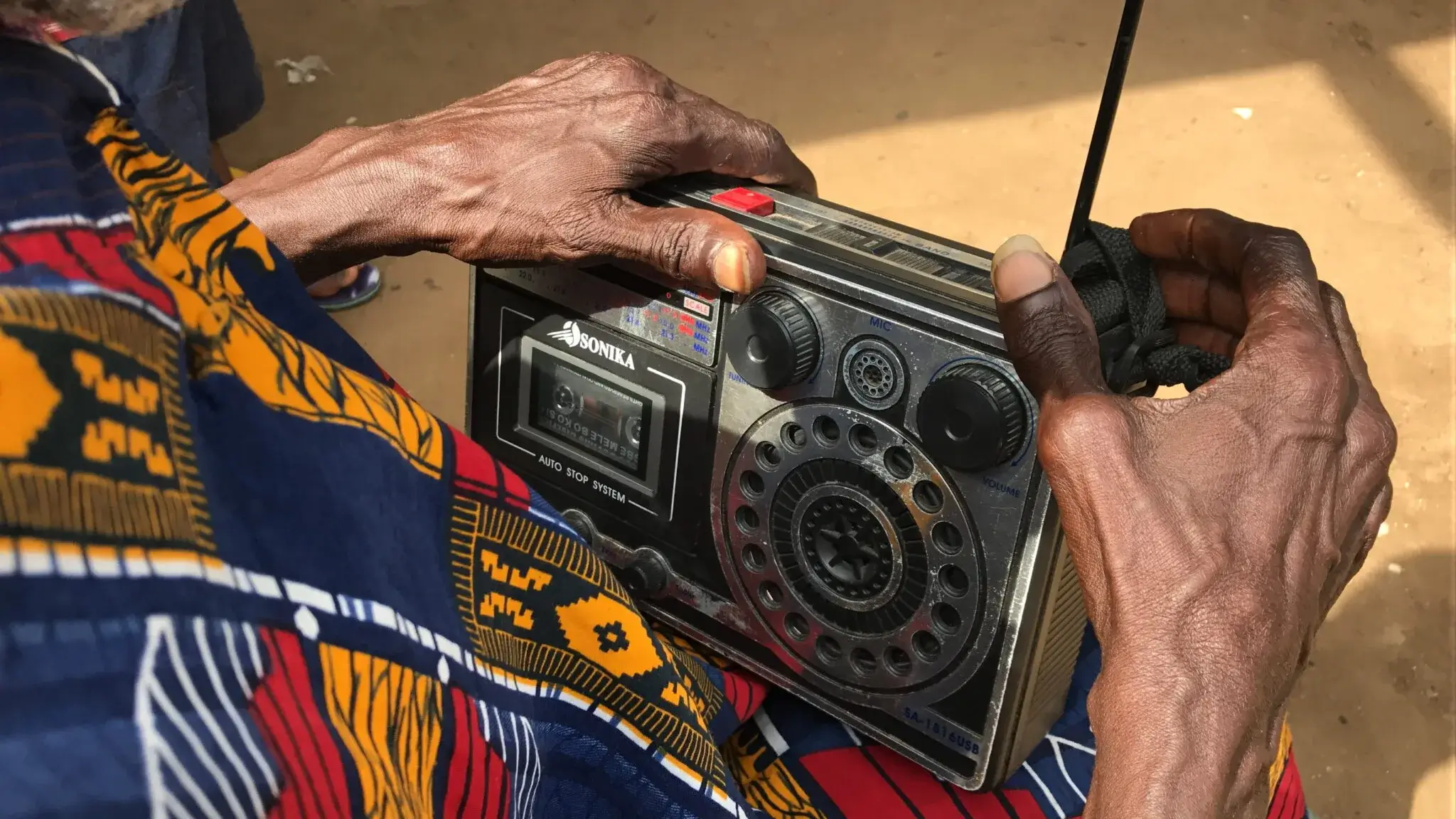
The oldest of the currently operating community stations is Radio Mang'elete, broadcasting on 89.1 FM from Nthongoni Shopping Centre in Kibwezi sub-county, Makueni County. It was started in the 1990s as a project of the Mang'elete Community Integrated Development Programme, a community-based organisation in the area, and it broadcasts primarily in Kamba with Kiswahili interspersed, on the air from six in the morning to ten at night. The audience is people who farm in a drought-prone semi-arid part of southeast Kenya, and the programming is what that audience actually needs to hear — agricultural extension, market prices, weather, government announcements, public health, the occasional missing-person notice, plus enough music and call-in talk to make the schedule listenable.
This is what rural community radio looks like in practice when it works. It is not a vehicle for inspirational stories about voicelessness. It is a small operation in a small shopping centre run by a registered local organisation, transmitting in the language people speak at home, addressing the specific concerns of the specific kilometre-radius it covers. The reason it has lasted thirty-odd years is that it is genuinely useful to its listeners, and the reason it has not scaled is that it is not trying to.
The framing of this essay — the role of community radio stations in rural Kenya — is mostly right, with one important caveat. Several of the most-studied stations in the Kenyan community radio sector are in urban informal settlements, not rural areas. Pamoja FM operates from a building overlooking Kibera in Nairobi. Koch FM operates from Korogocho. Ghetto FM is also Nairobi-based. The licence category is community, not rural, and the structural problems community radio addresses — exclusion from mainstream media, language mismatch, geographic underservice, audience-too-poor-to-monetise — exist in slums as urgently as they exist in Turkana. I'll come back to the urban stations because the Pamoja story in particular is one of the more remarkable things on the documented record. But the bulk of the sector is rural, and the bulk of this essay should be too.
Community radio stations in Kenya: where they broadcast
The rural community stations now operating cover a wider geography than most people realise. Here is where the documented stations sit:
| Station | Location | County / area | Notes |
|---|---|---|---|
| Radio Mang'elete (89.1 FM) | Nthongoni, Kibwezi | Makueni | Oldest operating; Kamba + Kiswahili |
| Mugambo Jwetu FM | Kianjai | Meru | Subject of 2014–2016 academic fieldwork |
| Wajir Community Radio | Wajir town | Wajir | Serves pastoralist hinterland |
| Baliti FM | Isiolo | Isiolo | Northern Kenya |
| Ata Nayeche FM | Turkana | Turkana | Pastoralist audience |
| Sogoot FM | Njoro | Nakuru | Rift Valley |
| Serian FM | Maralal town | Samburu | Northern pastoralist region |
| Sauti ya Wanjiku | Laikipia | Laikipia | Central/Rift borderland |
| Kangema RANET Community Radio | Kangema | Murang'a | 2024 audience study |
| Pamoja FM | Kibera | Nairobi | Urban informal settlement |
| Koch FM | Korogocho | Nairobi | Urban informal settlement |
| Ghetto FM | Nairobi | Nairobi | Urban informal settlement |
What community radio stations in rural Kenya actually do
Mugambo Jwetu FM broadcasts from Kianjai in Meru and was the subject of fieldwork by the Kenyan researcher R. Kimani between 2014 and 2016, published in the Intellect journal, examining how stations like it survive in the tension between international donor priorities (which emphasise democracy, freedom of expression, governance) and local political contexts (which require considerably more caution about how those values are expressed on air). Wajir Community Radio serves Wajir town and its pastoralist hinterland. Baliti FM broadcasts from Isiolo. Ata Nayeche FM operates in Turkana County. Sogoot FM is in Njoro. Serian FM broadcasts from Maralal town in Samburu County. Sauti ya Wanjiku covers Laikipia. Kangema RANET Community Radio, in Murang'a, was studied by Nancy Wanjiru Kungu, whose 2024 survey of its audience found that 62% of respondents preferred content delivered in their local language — a finding so unsurprising it would be insulting if it were not necessary, because national policy still rarely acts on it.
What these stations do day-to-day is roughly the same set of things, varied by region:
- Agricultural information, in places where the audience farms.
- Pastoralist information — water sources, grazing conditions, market prices, conflict alerts — in the north.
- Public health messaging, especially during outbreaks.
- Local government announcements, school news, missing-persons notices, deaths and funeral arrangements.
- Civic education during electoral periods.
- Music, talk, and callers to keep the schedule listenable.
The mix is unspectacular and indispensable, which is the right combination for a medium that is supposed to be useful rather than glamorous.
What they also do, which is less documented but more important than the donor-report version admits, is hold open a register of public conversation that no commercial station has a reason to host. A commercial FM station in Nairobi cannot afford to spend two hours of morning airtime on smallholder seed varieties in Tharaka-Nithi. A community station in Tharaka-Nithi can spend the two hours because that is precisely what its listeners are doing with their lives. The medium fits the audience because the audience built the medium.
The Pamoja FM story: community radio during the 2008 crisis
The single most remarkable documented incident in the recent history of Kenyan community radio happened in Kibera during the post-election violence of January 2008. The seven-storey building housing Pamoja FM was owned by a Kikuyu landlord, which during that violence was the kind of fact that got buildings burned. A mob did, by multiple accounts, approach the building intending to burn it down. The station's manager at the time, Antony Nyandiek, then twenty-three years old, went down to meet them. According to the documented account from The Advocacy Project, he told the mob that the radio station belonged to all of them, to everyone in the slum, to all the tribes and all the youth. They agreed, and they went elsewhere.
I would normally distrust a story this neat. The account is documented, named, and consistent across the sources that mention it. It happened. The reason it could happen — the reason a twenty-three-year-old station manager could persuade a mob to leave a Kikuyu-owned building alone by invoking the community ownership of the radio inside it — is the part of community broadcasting that the regulatory frameworks and the donor reports cannot quite capture. The station belonged to the listeners in a sense that mattered enough, in that specific moment, to stop a fire. That is the strongest argument for the licence category I know of, and it is not one that scales to a methodology.
The same period saw community and faith-based radio in several other parts of the country — Koch FM in Korogocho, Radio Waumini nationally — playing roles broadly similar to Pamoja's, lowering tensions where commercial vernacular stations were being credibly accused of raising them. The contrast was not absolute. But it was real enough that the post-election-violence period is now one of the few stretches of recent Kenyan media history where the small community stations come out of the analysis looking better than the big commercial ones.
The funding problem: why community radio in Kenya stays small
What community radio in Kenya cannot do, by law and by design, is fund itself the way Citizen and Classic and Milele do. The advertising restriction is not a bug. It is the structural feature that protects the category — without it, every community station would, within a decade, be commercially indistinguishable from any other FM station chasing the same regional audience. With it, every community station has to find another way to stay on air. In practice, that means donor partnerships. Pamoja FM has been funded primarily by USAID. Mang'elete is sustained by the Mang'elete Community Integrated Development Programme and its partners. UNESCO has supported training, equipment, and capacity-building across the sector. Faith-based organisations sustain a number of the stations that are technically not community-licensed but operate in similar ways.
The fragility this creates is the part of the story the optimistic accounts skip. International development funding shifts. The USAID priorities that funded Pamoja in 2007 are not the USAID priorities of 2026. The European Union, the Bill and Melinda Gates Foundation, the British Council, the various Scandinavian aid programmes — each has, at different times, sustained Kenyan community stations through donor cycles that ended, and stations that depended on them have, in several cases, ended with them. Mugambo Jwetu's experience, as documented in the academic literature, includes a constant negotiation between what funders want the station to be (a vehicle for governance and rights discourse) and what local audiences and local political context will permit (a more cautious, more development-oriented, less explicitly political operation).
The honest summary: community radio's real role in rural Kenya
Community radio in Kenya is small, structurally underfunded, and indispensable in the specific places where it works. There are roughly eleven currently licensed community stations covering a country of fifty-some million people, which is an absurdly thin layer of infrastructure for the sector to be carrying the load it carries. The role these stations play in rural areas and in urban informal settlements is not the heroic role the donor materials describe. It is a more practical role: filling the gaps the commercial market leaves, in the languages the commercial market does not bother with, on the topics the commercial market cannot monetise.
What the sector needs, and what it has needed since 1982, is a funding model that does not depend on international donor priorities and a regulatory framework that protects the non-commercial character without starving the stations of operating revenue. Neither is in place. The Communications Authority maintains the licence category in good faith. The donors come and go. The local communities that run the actual stations carry the rest.
The Pamoja story is the one I keep returning to, because it is the cleanest illustration of what community radio is supposed to be. A station the listeners owned, in a building a mob was going to burn, that did not burn because the listeners said no. That is not a model anyone has figured out how to replicate at scale. It is, however, the proof that something distinct from commercial broadcasting is happening in this category, and worth keeping alive for the days it matters most.
Frequently asked questions about community radio in Kenya
What was the first community radio station in Kenya?
The first community-based radio station in Kenya was established in Homa Bay in 1982, jointly initiated by the Kenyan government and UNESCO — thirteen years before commercial FM liberalisation in 1995.
How many community radio stations are there in Kenya?
There are roughly eleven community-based radio stations currently operating in Kenya, a number that has changed little in two decades, largely because of funding constraints.
What is the oldest community radio station still operating in Kenya?
Radio Mang'elete, broadcasting on 89.1 FM from Kibwezi in Makueni County since the 1990s, is the oldest of the currently operating community stations.
Can community radio stations in Kenya run advertisements?
No. Community broadcasting is a distinct licence category under the Kenya Information and Communications Act (1998) that is structurally barred from generating revenue through advertising the way commercial FM stations do. Stations rely on grants, donor partnerships, member contributions, and subsidy instead.
Are community radio stations only in rural Kenya?
No. The licence category is "community," not "rural." Some of the most-studied stations — Pamoja FM in Kibera, Koch FM in Korogocho, and Ghetto FM — operate in Nairobi's urban informal settlements, addressing the same exclusion and underservice found in remote rural areas.
What does community radio in Kenya broadcast?
Typical programming includes agricultural and pastoralist information, public health messaging, local government and school announcements, missing-persons and funeral notices, civic education during elections, and local-language music and call-in talk.
Explore more on Kenyan radio
Community radio is one slice of a much larger dial. For the bigger commercial and public picture, see our guide to the best Kenyan radio stations for news and current affairs, and browse all Kenyan stations on radio.co.ke.
Ready to listen? Stream live Kenyan radio stations free — no app required.
Browse All Kenyan Radio Stations →