How the Internet Changed Kenyan Radio: The Shift to Online Streaming

Orlando Lyomu, the chief executive of Standard Group, said something on Spice FM in 2020 that most people in Kenyan media already knew but rarely said out loud on air. The media industry, he said, had been on a slippery slope even before COVID-19, because of digital disruption — and he put it in terms that have stuck with me since: it was a case of the ship going down while you still had a few lifeboats, and you had to decide, either way, what to do about it. He said this on the radio. About the radio. While the industry he was describing was, in that exact moment, also quietly building the lifeboat — a livestream, a Facebook simulcast, a podcast feed — that would let it survive the thing he was warning about.
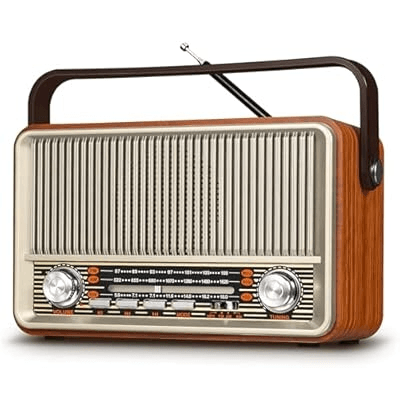
I am part of the generation that radio built its lifeboats for. I don't own a transistor radio. I have never owned one. My first relationship with Kenyan radio was a blue-and-white app icon on a Tecno phone, a Safaricom data bundle bought for twenty shillings, and Maina and King'ang'i's voices coming out of a tinny phone speaker on a matatu while I scrolled past the question of whether I'd have enough data left to also check Instagram. That is not how my parents experienced radio. It is, increasingly, the only way an entire generation of Kenyans has ever experienced it.
This is the story of how that happened — not as an abstract technology trend, but as a series of specific, datable moments when the infrastructure underneath Kenyan radio changed, and an entire industry had to decide whether to drown or build.
Before the Cable: Kenyan Radio in an Analogue World
It is hard to overstate how recently Kenyan internet access was a genuinely rare thing. As late as 2009, fewer than one in ten Kenyans had ever accessed the internet at all. Radio, by contrast, was the most universally accessed medium in the country, reaching close to nine in every ten people in national surveys — a reach internet would not approach for another decade.
The infrastructure simply wasn't there yet. Safaricom had launched basic mobile internet over GPRS and EDGE connections in 2004, giving Kenyans access to the web at a crawling 384 kilobits per second — enough to load a text-heavy webpage slowly, nothing close to what audio streaming would eventually require. For most Kenyans, "going online" in the mid-2000s was something done occasionally, at a cybercafé, not something carried in your pocket and switched on without thinking.
Radio, meanwhile, was doing exactly what it had always done: living on a transistor set, a car radio, or a flip-phone's built-in FM receiver, broadcasting on a single frequency to anyone within range of the transmitter. The idea that a station's signal might one day be just as available in Minneapolis or Manchester as it was in Mathare was not yet a serious commercial consideration.
2009: The Cable That Changed Everything
The single most consequential infrastructural moment in this entire story is one that has nothing directly to do with radio at all. In 2009, the East African Marine System — TEAMS, a 5,500-kilometre undersea fibre-optic cable — landed at Nyali in Mombasa County. Kenya's internet, until that point, had relied heavily on expensive, slow satellite links. The arrival of TEAMS, and Seacom's earlier 2009 East African cable, broke that bottleneck.
What followed moved quickly by African telecommunications standards. Safaricom launched 3G in 2008, with speeds climbing from 7.2 megabits per second to 21, then 42 megabits per second by 2010. The company began laying its own terrestrial fibre network in 2013, supporting the launch of 4G LTE in 2014 — the same year it introduced Home Fibre. By 2018, Safaricom added Voice over LTE, letting Kenyans browse and call simultaneously at 4G speeds. In 2022, Safaricom became the first operator in Kenya to launch 5G.
Each of these steps sounds like a telecoms trivia list. But each one removed a specific, concrete barrier between a Kenyan radio station and a Kenyan listener who wasn't standing within range of an FM transmitter. 384 kilobits per second cannot reliably stream audio. 21 megabits per second can, easily. Somewhere in that gap, Kenyan radio's relationship with its own audience was rewritten.
The M-Pesa Generation Gets a Smartphone
Kenya's mobile story cannot be separated from M-Pesa, launched by Safaricom in March 2007. M-Pesa didn't stream radio — but it normalised something just as important: the idea that your phone was not just for calls, but for doing real things that mattered to your daily life. By the time data bundles became cheap and smartphones became affordable — accelerated by initiatives like Safaricom's Lipa Mdogo Mdogo, which let Kenyans pay for 4G-enabled smartphones in small daily installments of twenty shillings — an entire generation had already learned, through M-Pesa, that their phone screen was where serious things happened.
Streaming radio simply slid into a behavioural groove that mobile money had already worn smooth. By the early 2020s, Kenya had tens of millions of internet subscriptions, the overwhelming majority of that traffic moving through mobile networks rather than fixed broadband. The radio industry didn't have to teach Kenyans to trust their phones. M-Pesa had already done that work.
What Actually Changed in the Studio: Stations Go Digital
For the radio stations themselves, the digital shift wasn't a single decision but a long accumulation of smaller ones, each responding to a specific pressure.
Simulcasting: One Broadcast, Many Screens
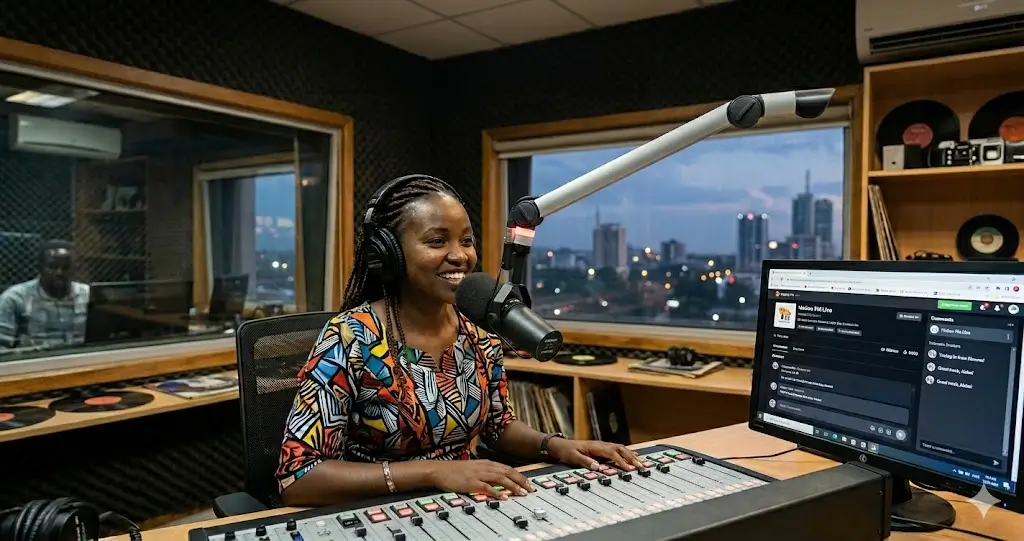
Kenyan stations increasingly began simulcasting their FM broadcasts on YouTube and Facebook Live, turning a purely audio medium into something with a visual feed — a presenter's face, a studio guest, a comment section scrolling in real time. This wasn't really a radio innovation; it was radio absorbing the logic of social media, where engagement and visibility matter as much as the content itself. A listener could now watch Maina and King'ang'i's facial reactions to their own jokes, not just hear the laughter.
The COVID-19 Acceleration
If there is a single hinge point where digital radio adoption stopped being optional and became urgent, it was the COVID-19 pandemic. A 2020 Media Council of Kenya survey found that 55% of Kenyans had more time to consume news and content during the lockdown period, and confidence in radio as a trusted source remained extraordinarily high, even as listening patterns shifted away from in-car and commuter contexts toward at-home, on-device listening. Stations like Radio Jambo launched dedicated interactive call-in formats addressing COVID-19 questions directly, bringing in virologists and public health experts to respond to citizen concerns in real time — content built explicitly for a moment when people were stuck at home with their phones and nothing else.
Behind the scenes, the pandemic was also brutal. Standard Group's Lyomu was blunt about an industry in decline even before COVID-19 arrived, and layoffs across Kenyan media were already underway. The pivot to digital wasn't purely a story of innovation and opportunity. For many newsrooms, it was survival under duress — a scramble to find any revenue model that wasn't tied to a print run or a drive-time ad slot that nobody was driving to hear.
From Station Broadcast to Personal Podcast
Perhaps the most significant shift wasn't stations putting their existing shows online — it was individuals bypassing stations entirely. Mantalk.ke, launched in 2019 by Eli Mwenda and Oscar Koome, built an audience of 170,000 subscribers across YouTube and social media without ever needing an FM frequency, a transmitter licence, or a slot on someone else's programming schedule. By 2024, research firm Odipo Dev found that Kenyan video podcasters were dramatically outperforming legacy broadcasters on their own home turf: podcaster Abel Mutua, with just 96 video uploads that year, drew more average views per video than Nation Media Group's entire output of 3,749 uploads over the same period.
That comparison should stop you. A single self-funded podcaster outperforming Kenya's largest media conglomerate's full digital output, video for video, is not a footnote. It is the clearest evidence available that the old institutional gatekeeping of Kenyan broadcasting — the studio, the license, the transmitter — had stopped being the thing that determined who got heard.
The Diaspora Connection: Radio Without Borders
Streaming did something FM radio structurally could not: it let Kenyan radio cross oceans. Vernacular stations like Inooro FM, Musyi FM, and Ramogi FM report significant listener bases entirely outside Kenya's borders, serving diaspora communities in the United Kingdom, the United States, the United Arab Emirates, and Australia who want to hear news, music, and language from home in real time, not delayed or filtered through a relative's WhatsApp forward.
This matters in a way that's easy to understate. A Kalenjin listener in Minneapolis streaming Kass FM, or a Luo listener in London streaming Ramogi FM, is not consuming content about home. They are participating in the same live broadcast moment as someone standing in a kitchen in Eldoret or Kisumu — the same call-in show, the same breaking news bulletin, the same shared experience of simultaneity that radio has always specialised in, just no longer bounded by a transmitter's physical reach.
Data Costs: The Quiet Enabler
None of this works if streaming an hour of radio costs more than a listener can spare. Audio streaming uses roughly 30 to 60 megabytes per hour depending on a station's bitrate — comfortably within the daily data bundles that have become standard across Kenyan mobile carriers. As Safaricom, Airtel, and Telkom have competed on bundle pricing, with daily data bundles now starting from around twenty shillings, the practical cost of streaming a full morning show has dropped to less than what many Kenyans would spend on a single matatu fare.
This is not a side detail. It is the entire reason streaming radio could become a mass behaviour rather than a wealthy urbanite's convenience. The infrastructure (the undersea cables, the 4G towers) made streaming technically possible. The pricing wars between mobile carriers made it financially trivial. Both had to happen before radio's migration online could become genuinely national rather than confined to Nairobi's better-connected estates.
What Hasn't Changed: Radio's Core Appeal
For all this disruption, it's worth being honest about what streaming did not replace. The Media Council of Kenya's research found that even amid digital growth, radio's trust ratings remained remarkably high — and crucially, this is not really a story about radio dying and something else replacing it. It is a story about radio's actual product — live, simultaneous, communal listening, anchored by a recognisable presenter's voice — surviving a complete change in delivery mechanism.
The breakfast show format didn't change. The call-in segment didn't change. What changed is that the breakfast show now exists simultaneously as an FM broadcast, a YouTube livestream, a Facebook video, and an on-demand podcast clip — four different doors into the same room. Radio didn't get replaced by the internet. It got distributed by it.
The Unfinished Argument: Who Owns Kenyan Radio's Future?
There is a tension running underneath this entire shift that the industry has not fully resolved. On one side sit the legacy broadcasters — Royal Media Services, Standard Group, Radio Africa Group — institutions with studios, licences, advertising relationships, and decades of brand trust, now racing to build digital wings onto analogue buildings. On the other side sit individual creators like Mwenda, Koome, and Mutua, who never needed a broadcasting licence at all and who are, by some measures, already winning the attention battle against the institutions built to dominate it.
This is not a uniquely Kenyan tension — it is the same disruption playing out in media markets worldwide. But it carries a specific local weight given how concentrated Kenyan radio ownership has historically been, and how much of the country's information ecosystem still depends on a small number of large broadcasters reaching rural and lower-income audiences who remain on FM, on a Tecno phone, on a data bundle bought twenty shillings at a time, exactly the way I was three years ago.
The infrastructure that made streaming possible — the TEAMS cable, the 4G towers, the cheap data bundles — is now essentially complete across Kenya's urban centres. What's still being decided is who gets to build on top of it: the institutions with the licences, or the individuals with the phones.
The undersea cable that changed Kenyan radio landed at Nyali in 2009 and nobody who heard their favourite presenter that morning had any idea what had just arrived on the coast. Seventeen years later, most of us couldn't tell you which frequency that presenter's station broadcasts on. We'd just open the app.
Ready to listen? Stream live Kenyan radio stations free — no app required.
Browse All Kenyan Radio Stations →