How Radio 47 Went From Zero to a Top-10 National Station in Under Two Years

When Radio 47 first crackled onto Kenyan airwaves in March 2023, the country's radio pecking order had barely shifted in years, with Radio Citizen and Radio Jambo holding the top of the chart the way they always had.
Under two years later, one of those giants had company it did not invite. Radio 47, a station that did not exist at the start of 2023, had climbed to second most-listened in the country.
It is one of the fastest rises Kenyan broadcasting has seen, and you can stream the station live on Radio.co.ke to hear what the fuss is about.
The Numbers Behind the Climb
The scale of the jump is easier to grasp through the rankings themselves.
Radio 47 launched on 13 March 2023 under Cape Media Limited. By the Media Council of Kenya's 2024 survey covering the previous year, it had already broken into the "Big Five" with a 5 per cent listenership share, prompting MCK chief executive David Omwoyo to remark that the newcomer was clearly doing something right.
The Ipsos Kenya Audience Tracker then charted a station that would not stop climbing. It sat third among national Swahili stations in the fourth quarter of 2024, rose to second nationally by the first quarter of 2025 with a 7.5 per cent market share, and closed the year at second place with a 9 per cent share by December 2025.
Ahead of it sat only Radio Citizen, the Royal Media Services heavyweight that has topped the chart since 2021, holding a commanding 17.3 per cent reach and a 20 per cent share.
A brief word on what those figures mean. Audience reach is the number of unique people who tune in to a station, while audience share is the average percentage of listeners it commands at a given time — and Radio 47 climbed on both, in a market where 33 million Kenyans still reach for the radio.
Poaching the Voices That Already Had an Audience
The strategy behind the numbers was not subtle. Radio 47 bought its way to the front of the queue by hiring the presenters listeners already followed.
The station launched with a roster drawn straight from its rivals, among them veteran Swahili sports commentator Hassan Mwana wa Ali, gospel favourite Eva Mwalili, known on air as Mama Taifa, and breakfast heavyweights Emmanuel Mwashumbe and Alex Mwakideu, later joined by comedian Dr Ofweneke fronting the late-night slot.
It is a tactic as old as commercial radio, but few Kenyan stations have executed it at this scale on day one. The audiences those presenters had built elsewhere followed them to 103.0 FM, and the loyalty transferred with them.
The Station Built for Screens, Not Just Speakers
Radio 47 also arrived with a pitch no established rival could match: it was built to be watched.
The station bills itself as Kenya's first fully audio-visual, IP-based urban Swahili broadcaster, producing its shows for screen as well as speaker from the ground up. In February 2025, as it approached its second anniversary, Cape Media unveiled an ultra-modern, fully IP-based studio it described as the first of its kind in Africa, a facility later recognised internationally as the continent's most advanced.
That digital-first bet has paid off beyond the FM dial, with the station reporting more than 200 million monthly views across its platforms.
Who Is Behind Radio 47
The money and the ambition trace back to one man. Radio 47 is owned by Cape Media Limited, an affiliate of Mount Kenya University, and both are the work of Prof. Simon Gicharu — the entrepreneur and educationist who founded the university and rose, by his own telling, from milk vendor to billionaire.
Cape Media also runs the free-to-air television station TV47, giving the group a foothold across television, radio and digital. Within months of going on air, Radio 47 had already picked up a Kuza Broadcasting Award from the Communications Authority of Kenya, an early signal of the trajectory to come.
Where the Growth Came From
The rise did not draw evenly from every corner of the country. Radio 47 has kept its strongest presence in Nairobi, the Rift Valley and the Coast, the same regions where its Swahili-first, urban format lands hardest.
That footprint matters in a market where radio remains stubbornly dominant. Even against streaming and digital audio, roughly 80 per cent of Kenyan adults still listen to radio on a weekday, and the station's growth came by taking share from established names — Kameme FM, Radio Jambo and Ramogi FM among those that slipped as Radio 47 rose.
You can browse the stations it now sits alongside by region or genre on Radio.co.ke, from Radio Citizen and Radio Jambo to Kiss FM.
How to Listen to Radio 47
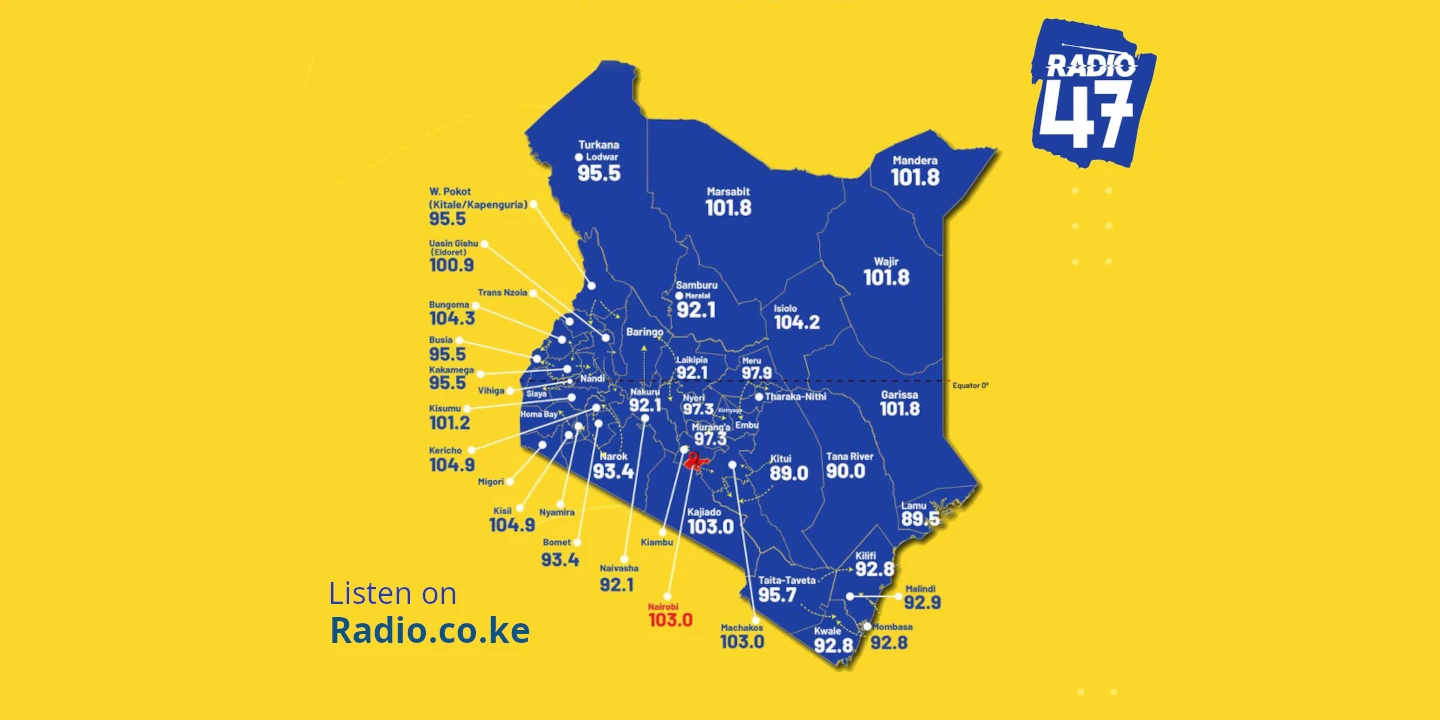
Radio 47 broadcasts on 103.0 FM in Nairobi and across more than 20 frequencies nationwide, including 92.9 FM in Mombasa, 100.9 FM in Eldoret and 95.5 FM in Kakamega.
Wherever you are, the station streams free on Radio.co.ke — no app, no sign-up. Tune in to Radio 47 online, or explore the rest of the country's stations, from Nairobi to Mombasa, on the full directory.
Whether Radio 47 can close the remaining gap on Radio Citizen, or holds its ground the way the giants it overtook could not, is the question the next Ipsos tracker will answer.
Ready to listen? Stream live Kenyan radio stations free — no app required.
Browse All Kenyan Radio Stations →